Articles & techniques
The Bulle magnetometer
A compass, a board and a ruled line: the simple home-made instrument used in the Horologix workshop to check the strength of every Bulle magnet, and what its readings mean.
Why the magnet matters
A Bulle clock is driven by the interaction between the coil on its pendulum and a fixed permanent magnet at the base. Each time the contact pin meets the fork, a short pulse of current through the coil creates a field that works against the magnet’s field and pushes the pendulum on its way.[3] If the magnet has weakened over the years, each impulse is weaker too, and the clock may lose amplitude or stop altogether.
Bulle magnets do weaken. They are made with three poles rather than the usual two, and the opposing poles meeting in the centre of the bar cause the magnet to lose strength gradually over its life.[3] Checking the magnet is therefore a regular step in the restorations on this site, and re-magnetising it is one of the more common jobs.
The instrument
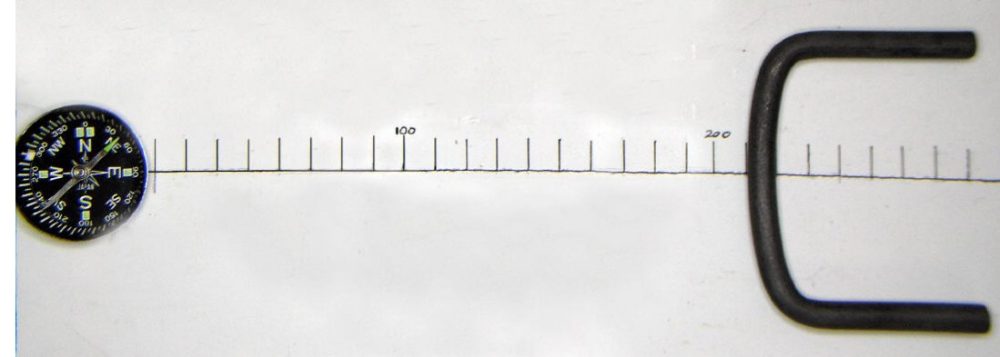
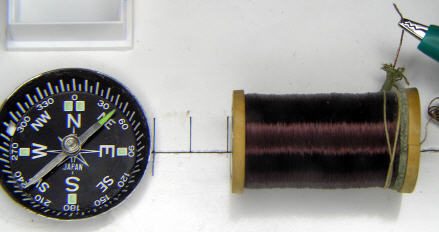
The magnetometer is described in the restoration notes for Bulle Nº 186300 and Nº 174475. It is deliberately simple:
- A compass is fixed permanently to a board.
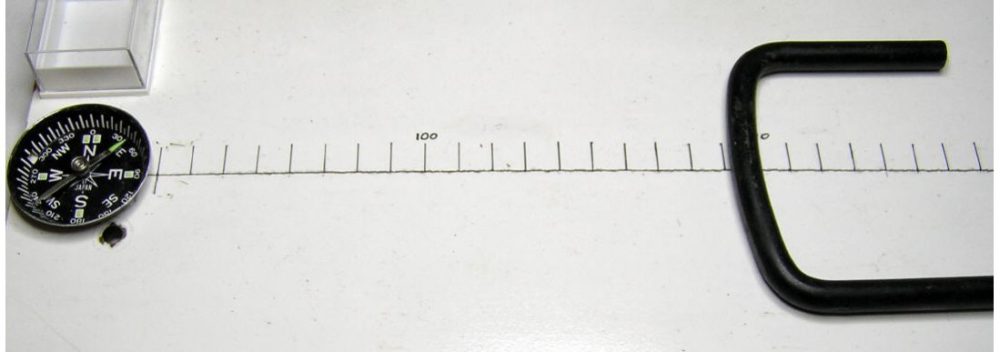
- A scale is drawn along the compass’s east–west line, marked every 10 mm and numbered in millimetres from the centre of the compass.
- The board is turned until the needle points north, and left to settle with no other steel or iron nearby.
- The magnet is slid in along the scale from the right until the needle is deflected to 45°.
- The distance from the centre of the compass is read off the scale.
The further away the magnet is when the needle reaches 45°, the stronger the magnet. As the notes for Nº 174475 put it, the device is “simple but good enough to show how strong the magnet is and how effective the regeneration has been.”
Why 45 degrees?
A compass needle normally lines up with the horizontal part of the Earth’s magnetic field. When a second field acts at right angles to it, the needle settles at an angle whose tangent is the ratio of the two fields. This is the “tangent law” used in classic deflection magnetometers.[1]
At 45° the tangent is exactly 1, so the magnet’s field at the compass is equal to the Earth’s horizontal field.[1] The Horologix method uses that as a fixed yardstick: every magnet is moved to the point where its field matches the Earth’s, and the distance at which that happens becomes its score.
What the numbers mean
A magnet’s field falls away very quickly with distance. Well away from a bar magnet, along its line, the field weakens roughly with the cube of the distance.[1] That makes the scale more sensitive than it looks. Under that approximation, a magnet that reaches 45° at 180 mm has about (180 ÷ 150)³ ≈ 1.7 times the strength of one that does so at 150 mm. Close to a magnet of this size the rule is only approximate, so the readings are best used as they are in the workshop: to compare magnets of the same type on the same board.
The yardstick itself also varies a little. The Earth’s field differs from place to place and changes slowly over time, with the main dipole currently declining by about 6% per century.[2] Readings taken on one board in one workshop are consistent with each other, but should not be compared directly with readings from a different instrument elsewhere.
Readings from the restorations
These figures are taken from the individual restoration notes. Each clock links to its PDF.
| Clock | As found (mm) | After (mm) | Notes |
|---|---|---|---|
| Wall clock (no serial) | 160 | 190 | Original magnet stamped “Allevard” |
| Nº 5962 | about 150 | 180 | |
| Nº 11536 | — | 190 | Had been wrongly re-magnetised with two poles; restored to three |
| Nº 26443 | a little weak | 180 | |
| Nº 57561 | 140 | 180 | |
| Nº 65897 | 140 | 180 | |
| Nº 67438 | — | 180 | |
| Nº 123079 | 160 | — | Medium frame: shorter magnet, 160 mm is normal |
| Nº 174475 | 160 | 193 | |
| Nº 183374 | 160 | 210 | “A strong and very healthy magnet” |
| Nº 186300 | about 170 | about 205 | |
| Nº 252502 | about 150 | 180 |
A clear pattern emerges. Magnets that had weakened typically read between 140 and 160 mm and were brought back to 180 mm or more. The notes give the working rule in slightly different ways: a magnet below about 170 mm “is a little weak for the Bulle clock and should be regenerated” (Nº 174475), and “I re-magnetise any magnet that falls below 180 mm” (Nº 186300). In practice the target for a standard tall movement is 180 mm or better, with strong magnets reaching 190–210 mm.
Not every Bulle should reach that figure. The medium-frame movement of Nº 123079 has a shorter magnet, and 160 mm is its normal reading rather than a sign of weakness.
Three poles, not two
The magnetometer also shows whether a magnet has the right polarity. A Bulle bar magnet must have three poles: the same pole at both ends and the opposite pole in the middle. The usual arrangement is south–north–south, although, as the notes for Nº 174475 point out, north–south–north works equally well provided the battery connections are reversed to suit. Three-pole magnets of this kind go back to Marcel André-Moulin’s design of 1912, which preceded the Bulle patent of 1920.[3]
Getting this wrong is a real hazard. The magnet in Bulle Nº 11536 had been re-magnetised by someone with only a north and a south pole: “someone has re-magnetised it but did not understand the working of a Bulle.” It was corrected to the normal three-pole pattern and then read 190 mm. On Bulle Nº 183374 a previous owner had scratched “S” on one end and “N” on the other. A compass showed both ends were in fact south, as they should be, with north at the centre.
Later clocks are different. The very late Nº 342201, probably from the 1940s, has a much smaller cobalt magnet fixed on one side only. It is magnetised with just two poles, and it could not be brought back to full strength even after re-magnetising.
The “Allevard” stamp
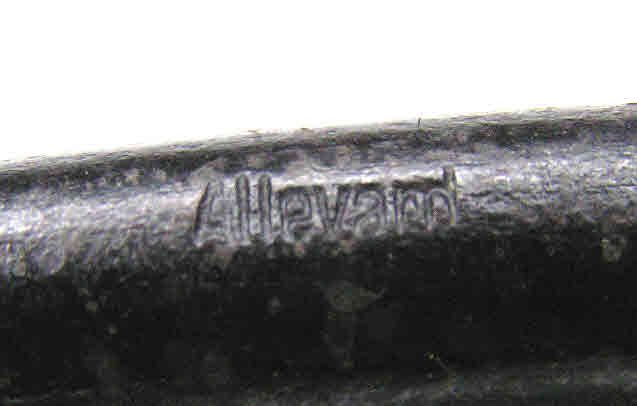
A few early magnets carry a stamped name, read variously as “Allevam”, “Allevard” or “Allevarn”. The notes for the pre-serial wall clock suggest it is most probably the name of the town rather than a maker. Allevard, in the Isère department of south-east France, was an iron- and steel-making centre for centuries, with forges recorded there by 1450 and steel production for railway markets growing from the 1840s.[4] Martensitic steel was made there from locally mined iron from 1870, and magnet production in the Allevard area began in 1902. A magnet factory still operates at nearby Saint-Pierre-d’Allevard.[5] That makes Allevard a very plausible source of Bulle magnet steel, although the link is not confirmed by any document on this site.
Other uses of the magnetometer
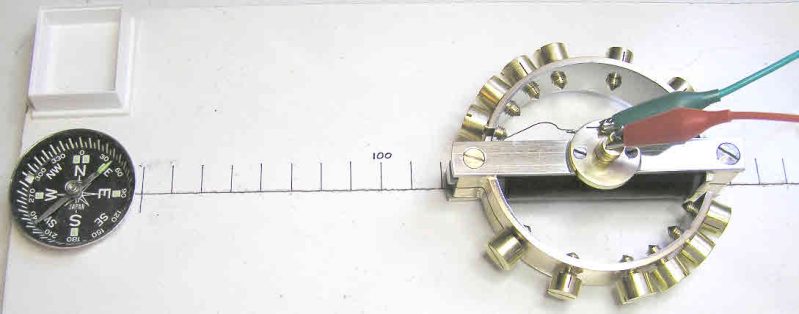
Eureka armatures. The same board is used on Eureka clocks. The balance-wheel coil is connected to a 1.5 volt battery, and its soft-iron armature concentrates the field so it can be measured in the same way. A healthy armature should move the needle to 45° at about 120 mm (Eureka Nº 404 and Nº 9082).
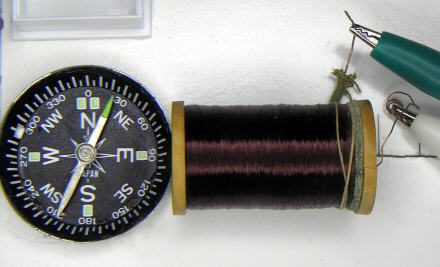
A coil experiment. The notes for Bulle Nº 12199 include a demonstration of how much difference an iron core makes. With 1.5 volts through a bare coil, the compass moved only about 20°, even with the coil pushed right up against it. With a soft-iron bar inside the coil, the field was strong enough to swing the needle round to east, and the coil had to be moved about 20 mm back along the scale to bring it to 45°. Once the current was switched off, the iron kept almost none of its magnetism. That is exactly the property wanted for the core of a Eureka clock coil.
Finishing the magnet
Once a magnet reads correctly it is cleaned and blacked. Fire-grate black is preferred to spray paint. The magnet is slid in and out of its brass clamps many times while the clock is set up and tested, and paint tends to scratch and peel, while grate black gives a durable, quiet lustre.
Sources
Workshop methods, readings and quotations are from the Horologix restoration notes linked above. Other information is from:
- Deflection magnetometer: theory (tangent law and the field of a bar magnet). Virtual Labs, Amrita Vishwa Vidyapeetham. https://em-amrt.vlabs.ac.in/exp/deflection-magnetometer/theory.html
- An overview of the Earth’s magnetic field. British Geological Survey. https://geomag.bgs.ac.uk/education/earthmag.html
- Bulle clocks. NAWCC Chapter 72 (Australia) archive. https://www.aussieclocks.com.au/archive/bulle-clocks/
- Allevard. Wikipedia. https://en.wikipedia.org/wiki/Allevard
- About us: history of magnet production at Allevard. Euromag. https://www.euromag-magnets.com/en/about-us/